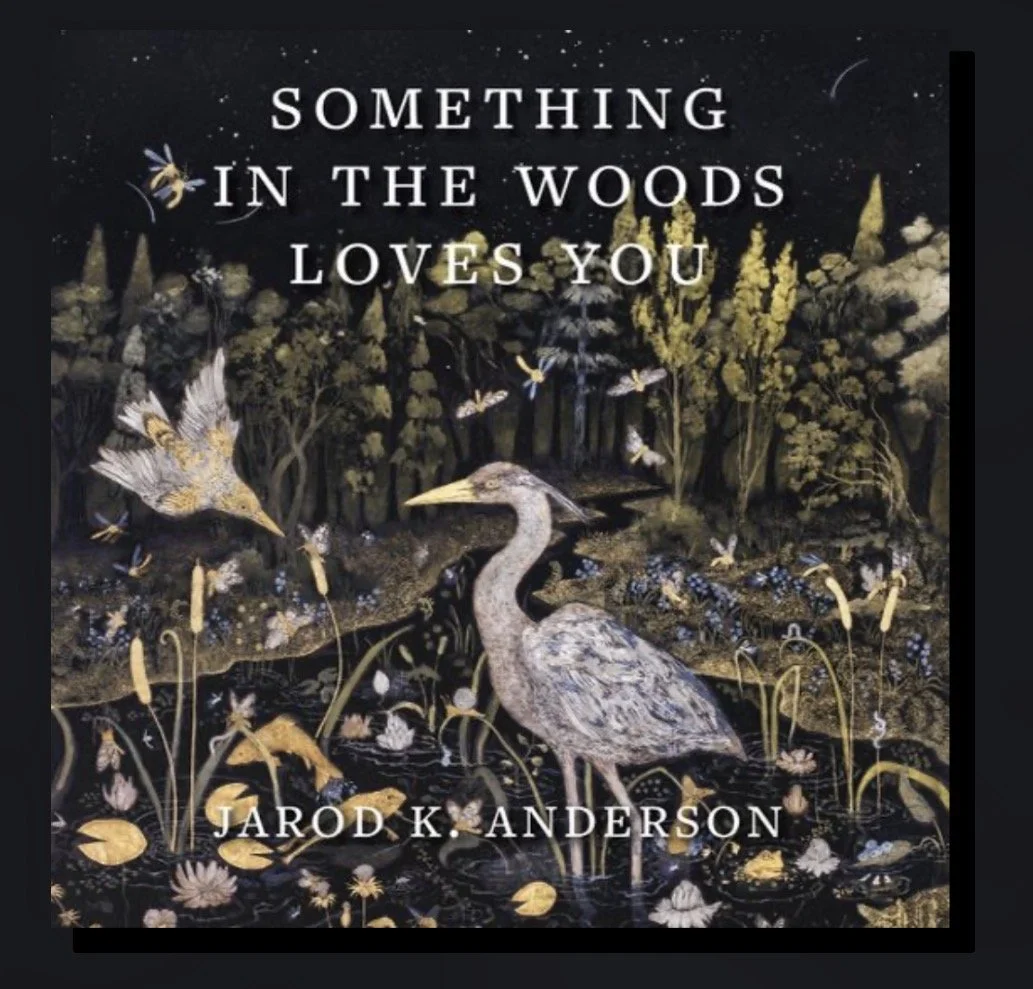
Something in the Woods Loves You (2024) by Jarod K. Anderson
Jarod K. Anderson, a writer and poet, shares his story of healing and recovery from depression with the goal to offer help and support to others by way of embodying the value and need for connection and community to thrive. His experience of healing was anchored in his love and awe of nature and he is able to weave in anecdotes of fact and imagery about various natural elements to mirror his healing, lessons learned, shifts in perspective and insight that align with the Transtheoretical Stages of Change model that was presented to him early on in his recovery process by his therapist, Mark. Jarod exemplifies a shift from a disconnected, passive, extrinsically motivated lifestyle to one of connection, community, intention, agency, participation, meaning-making, and magic. Jarod finds healing in the experience of shifting from doing to being.
How was this book recommended to me? I’ve seen this book recommended multiple times in various listservs and online networking groups.
Would I recommend this to my colleagues? Yes
Would I recommend this to my clients? Yes
How do I apply this content to my work: While Jarod K. Anderson consistently describes the benefits he received from the use of CBT (Cognitive Behavioral Therapy) as the primary modality in his treatment and recovery. While this is not a primary modality for me, I do incorporate this technique in smaller levels and appreciate what it has to offer. Additionally, Jarod consistently reflected on the Transtheoretical Model Stages of Change, which is something I refer to a LOT to help establish realistic expectations for the healing process. I share this information with my clients and their families (in the family education group that I facilitate at a local residential treatment center for dual diagnosis treatment). At one point, Jarod indicates that “failure is the only way to improve”, and I think it’s important to reflect on the valuable role of relapse in our recovery process as an opportunity to learn and grow rather than as a failed attempt to heal that we should be ashamed of (though I never want to invalidate that relapse can also come with distressing consequences). I appreciate that his story exemplified the process rather than the outcome, sharing mistakes, relapses, and challenges with vulnerability.
Additionally, as a provider who utilizes Polyvagal Theory as a primary foundation for my work, I couldn’t help but experience Jarod’s story from this lens and notice how his story exemplified experience(s) of moving up and down the ladder (in a way that paralleled movement through the Stages of Change) as he is able to anchor into safety via community, connection, and nature. Identifying triggers related to meeting external expectations, Jarod connected with a neuroception of safety as he walked through the woods–no expectation to fill a role, just an invitation to be; combined with a layer of nostalgia wherein Jarod describes a history of seeking safety and connection with nature as a kid. There’s a fair amount of research indicating different ways our experiences in nature can soothe our nervous system, whether it is elements of soil or trees, or the comparable anatomical structure of the nervous system in all mammals that allows humans to co-regulate in safety with animals when humans or man-made environments don’t feel safe.
If you live in WA state and feel like you are feeling depressed and disconnected, contact me. Let’s schedule a free 15-minute consultation and see if we might be a good fit to work together.