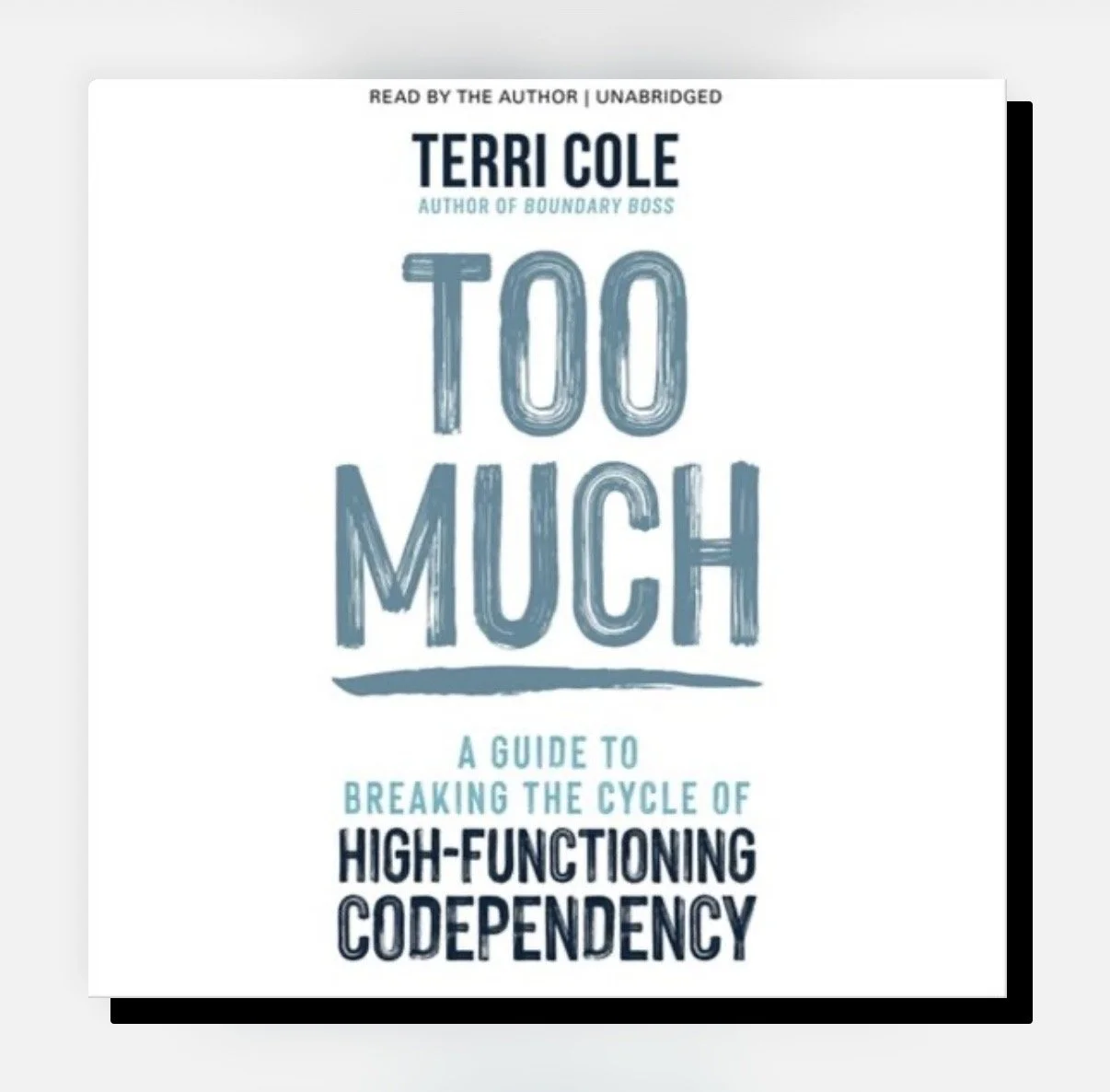
Too Much: A Guide to Breaking the Cycle of High-Functioning Codependency (2024) by Terri Cole, MSW, LCSW
Terri Cole, a licensed therapist, provides an updated perspective on co-dependent relationship patterns. Originally identified in the context of spouses of alcoholics, Cole uses a combination of client composites and personal anecdotes to exemplify the variety of ways that co-dependent patterns show up in ALL kinds of relationships–familial, romantic partnerships, platonic friendships, colleagues, etc., and coins the term “high-functioning codependents" (or HFC for short) to encompass the hyper-independent side to the same co-dependent coin of the person who can (and often does) everything for self and others and whose porous boundaries lead to burnout, resentment, and exhaustion. The book’s first half highlights different presentations of co-dependency and the second half of the book outlines steps for recovery. And then the back of the book contains a variety of supportive resources to help you along the way.
How was this book recommended to me? Clients were reading it.
Would I recommend this to my colleagues? Yes
Would I recommend this to my clients? Yes
How do I apply this content to my work: As a trauma and addictions therapist, I come across various presentations of co-dependency. Often co-dependency/hyper-independency were developed as a survival response to unhealthy relationship dynamics and then get repeated and replayed in all of our relationship dynamics throughout our lives. I, myself, am a co-dependent/hyper-independent in recovery, someone who has always done “too much” — both because it helped me to feel needed and give me purpose in relationships, and partly due to my empath hyper-sensitivities that lead boundaries to be so physically and emotionally uncomfortable that avoidance was preferable. In becoming a therapist, I learned about boundaries and how it was my job to assert them: namely, to never work harder than my clients. And that was one of my first lessons in boundaries and probably one of the first times I was given permission (nay, mandated) to assert a boundary (and learned the value of it not only benefitting me, but those I’m asserting the boundary with—my clients in this case). And I have since recognized how the experience of over-functioning/under-functioning has shown up in so many of my relationships (and once you start to see it, you can’t unsee it). And I see it in my clients. And as I continue to work on improving my own distress tolerance to assert and maintain healthy boundaries in my relationships with others, I model it for my clients, as well as guide my clients (and sometimes their families in my Family Education Group at the treatment center, and/or during family sessions in my private practice) through the same/similar practices of understanding the concept of co-dependency, seeing how it has been playing out in their relationships and/or contributing to the decline in health/mental health, and developing skills around healthy boundaries to re-build relationship dynamics based on a foundation of reciprocal inter-dependence (also correlated with secure attachment styles).
If you live in WA state and feel like you need support with shifting your relationship dynamics from co-dependent to inter-dependent, contact me. Let’s schedule a free 15-minute consultation and see if we might be a good fit to work together.